Political Animals by Rick Shenkman
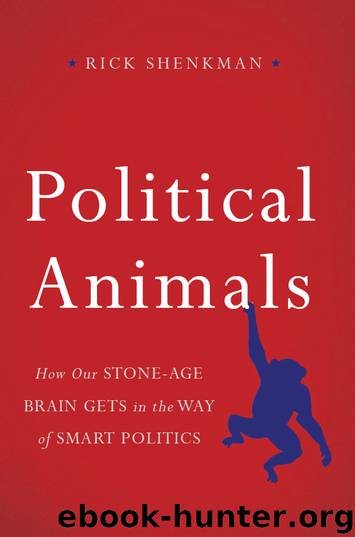
Author:Rick Shenkman
Language: eng
Format: epub
ISBN: 9780465073825
Publisher: Basic Books
Published: 2015-11-14T16:00:00+00:00
4.
Think of all the ways our lives and culture are defined by myths. The Virgin Birth? A myth. The British Stiff Upper Lip? Myth. William Tell? Myth. Everywhere around us, in all directions, in all aspects of life, there are myths. When the president of the United States invokes freedom, he’s laying claim to a myth. When we speak of George Washington, what do we have in mind? Not the man, but the monument. Pilgrims landing at Plymouth Rock? Betsy Ross making the first American flag? The Liberty Bell tolling to signal independence? They’re all myths. Every society on earth has these so-called Foundation Myths (that have to do with origins) and many others. The universality of myths suggests they are one of our most significant evolved psychological mechanisms. This goes far toward explaining one of the most troubling facts historians have uncovered about myths: they don’t die. They just go into hibernation, ready to spring back to life when circumstances become favorable. Take Joseph Stalin. He was officially repudiated by the Soviet Union shortly after his death in 1953. His horrors were fully exposed. But on the sixtieth anniversary of his death, who did Russians tell pollsters was the greatest Russian leader in history? Joseph Stalin. It’s not the man Russians were celebrating. It was the myth of the Great Leader. In myths, fact and fable get all mixed up. The facts are incidental. What counts is the meaning the myths have for the people who believe them.
Americans, like others, are susceptible to myths. The reason for this is that myths serve the same purpose for us as they do for others. As the psychologist Jonathan Haidt points out, myths bind groups together. They bind the hive. Myths bring us closer. As a heterogeneous society we have more of a need for myths than homogenous societies. Unlike most people around the world, our history is short—so short, we have not had time to meld into a single people with a common culture. We come from everywhere. Unlike, say, the Germans or the French, we have not lived in the same place for thousands of years. Nor do we share a common tribal identity. E pluribus unum? Out of many one? That is what we like to believe, but it’s not really true. What unites us is not a common identity but a loose set of beliefs. This is why myths are so appealing to Americans. They help answer the burning question, to quote the eighteenth-century French émigré writer J. Hector St. John de Crèvecoeur: “What then, is this new man, the American?” Two centuries on we still aren’t sure, but a clue is in our myths. Our myths make us, us. We therefore cling to them and can’t give them up. It’s who we are. Myths are so important to us that writers and intellectuals after the Revolution set themselves on a conscious path of mythmaking. This was to create an authentic American identity. They did not want children growing up on the stories of Robin Hood and Sherwood Forest.
Download
This site does not store any files on its server. We only index and link to content provided by other sites. Please contact the content providers to delete copyright contents if any and email us, we'll remove relevant links or contents immediately.
Rewire Your Anxious Brain by Catherine M. Pittman(18638)
Talking to Strangers by Malcolm Gladwell(13342)
The Art of Thinking Clearly by Rolf Dobelli(10444)
Mindhunter: Inside the FBI's Elite Serial Crime Unit by John E. Douglas & Mark Olshaker(9313)
Becoming Supernatural by Dr. Joe Dispenza(8196)
Change Your Questions, Change Your Life by Marilee Adams(7753)
Nudge - Improving Decisions about Health, Wealth, and Happiness by Thaler Sunstein(7689)
The Road Less Traveled by M. Scott Peck(7592)
The Lost Art of Listening by Michael P. Nichols(7487)
Mastermind: How to Think Like Sherlock Holmes by Maria Konnikova(7314)
Enlightenment Now: The Case for Reason, Science, Humanism, and Progress by Steven Pinker(7305)
Win Bigly by Scott Adams(7183)
The Way of Zen by Alan W. Watts(6594)
Daring Greatly by Brene Brown(6501)
Big Magic: Creative Living Beyond Fear by Elizabeth Gilbert(5753)
Grit by Angela Duckworth(5598)
Ego Is the Enemy by Ryan Holiday(5412)
Men In Love by Nancy Friday(5231)
The Laws of Human Nature by Robert Greene(5170)
